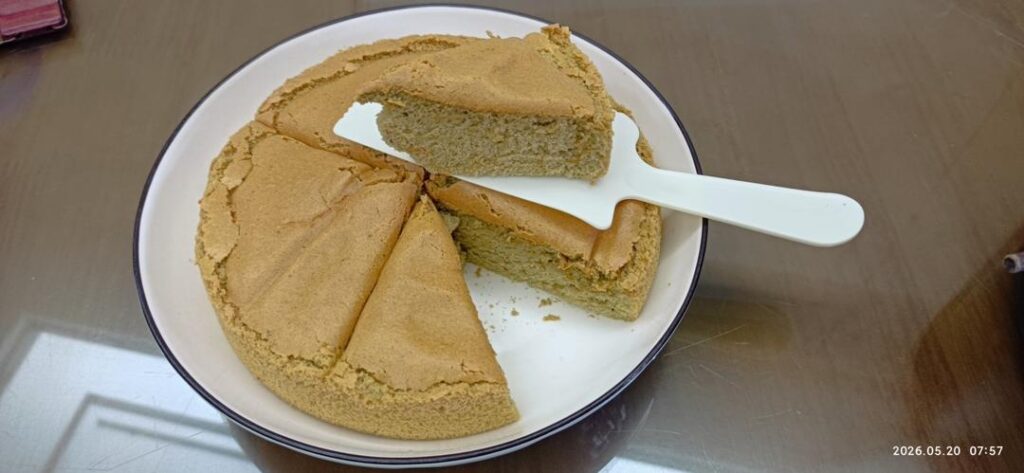
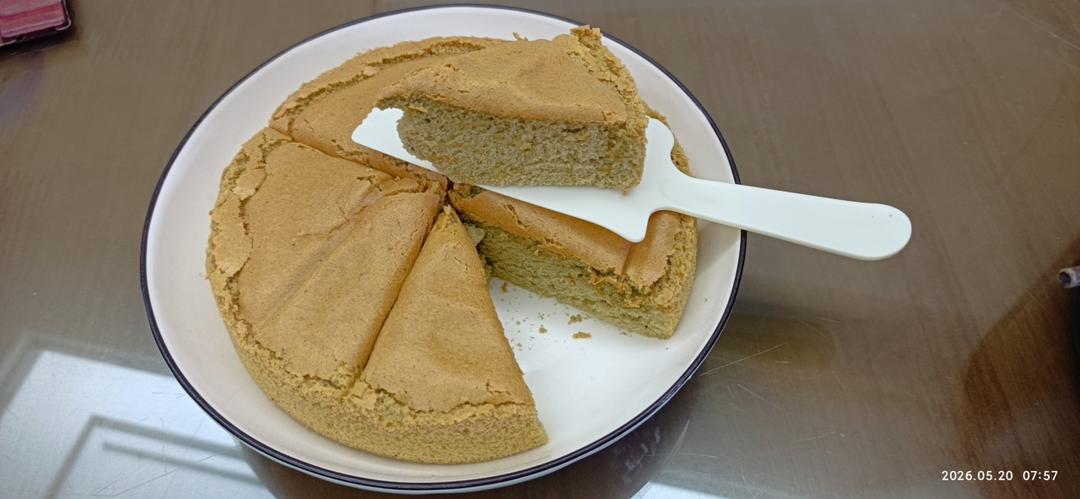
Simply documenting my own experience, the method follows the chiffon cake approach.
Ingredients:
Cornstarch 10 g
Matcha powder (for enhanced flavor; optional) 3 g Prepare all ingredients. Separate the egg whites from the egg yolks. Place the egg whites and sugar in a clean, water-free and oil-free bowl. Place the egg yolks, milk, oil, flour, and cornstarch in another bowl. The amount of sugar in this recipe is not very sweet; those who prefer sweeter cake may add additional sugar to the egg yolk mixture. PS: 40 g flour plus 10 g cornstarch can be replaced by 50 g cake flour. Cake is traditionally made with cake flour, but since I rarely bake, I have not purchased cake flour and instead use a mixture of flour and cornstarch at a 4:1 ratio as a substitute. Stir the ingredients in the egg yolk bowl in a Z-shaped motion until smooth and free of lumps, achieving a thick yogurt-like consistency. PS: If time permits, the ingredients may be added in the order of milk plus oil, then flour plus cornstarch, then egg yolks, and stirred until uniform after each addition. This time I wanted to test the result of mixing everything at once, so all ingredients were combined in a single step. After completion, I found that there seemed to be no difference from adding ingredients in stages and stirring multiple times. Add sugar to the egg whites and whip until the beaters lift out small peaks, the meringue does not flow, and it does not fall when the bowl is inverted. Because I work slowly and am concerned about deflation, I tend to whip it stiffer than needed and often cannot judge accurately, sometimes even overwhipping. Sugar may be added in three portions during whipping; for specific methods, please refer to tutorials on whipping egg whites.Fold one-third of the meringue into the flour batter. Use a fast folding motion, scraping from the bottom and lifting upward, while stirring quickly and continuously.
The resulting batter should be relatively thick and consistent.
Pour the mixed batter back into the remaining meringue. Fold quickly and evenly in the same manner. Do not worry excessively about deflating the foam; rapid and uniform folding is what matters. The more you worry, the more likely the foam will deflate.
A well-mixed cake batter will contain many visible air bubbles, and traces made by the spatula will not disappear easily.
Pour the cake batter into the cake mold. Lift it slightly and tap it a few times to release large air bubbles. Use a toothpick to draw a few lines through the batter to remove smaller bubbles.
Cover the top of the cake mold with a layer of aluminum foil and poke a few holes in it with a toothpick, then place it in the air fryer. I had run out of aluminum foil at home, so I used a steaming rack as a substitute. Bake at 155°C for 1 hour. If covering with aluminum foil, I previously baked at 170°C or 165°C for 1 hour, then removed the foil and baked at 140°C for 3 minutes to brown the surface.
This is how it looks after baking. Insert a toothpick and pull it out; if no raw batter comes out, it is done.
After baking, remove the cake from the oven and tap it lightly a few times while holding it. Invert it onto a elevated rack to cool. I placed a pair of chopsticks on a plate and set the cake on top.
Unmold the cake. Front side.
The bottom reverse side. Pressing both the front and reverse sides results in spring-back.
That is roughly how it is. Personally, I think it is quite delicious.