Very aromatic, with added vanilla seeds and lemon zest, much more fragrant than adding matcha powder alone! This makes 10 cake cups, though 9 cups would also suffice. The ingredient quantities are the same as for a 6-inch cake mold, but baking time in a cake mold is longer than in foil cups. For a 6-inch cake mold, the temperature and time are: high-temperature quick baking at 170–180°C for 28–30 minutes; low-temperature slow baking at 140–145°C for 65–70 minutes.
Ingredients:
80ml
Vanilla pod seeds
¼ pod
Corn oil
50g
Lemon zest
¼ lemon
Lemon juice
3g
Salt 1g
5 eggs, separate egg whites and yolks. (Place egg whites in a large bowl for convenient subsequent whipping.)
10g matcha powder.
Ordinary matcha powder can be dry-fried over low heat for 30 seconds to enhance aroma.
70g cake flour. (Excess flour makes the batter too thick, resulting in excessive tension during baking and severe cracking.) (Next time, plan to use 65g cake flour to adjust the batter to a smooth consistency that flows slowly.)
Combine matcha powder and cake flour.
Sift the dry ingredients into a large bowl.
45g granulated sugar, set aside.
80ml milk, add ¼ vanilla pod seeds. (Compared to the version without matcha powder, 20ml more milk is used.)
50g corn oil. (This is 10g less corn oil compared to the version without matcha powder.)
Heat the corn oil over medium-low heat until small bubbles appear around a wooden chopstick. (Alternatively, heat in a microwave on medium power for 2 minutes.) Pour in the flour. Quickly stir with a wooden chopstick in a “Z” motion until evenly combined. Pour in the milk and vanilla seeds. Quickly stir with a wooden chopstick in a “Z” motion until evenly combined. Pour in the egg yolks. Quickly stir with a wooden chopstick in a “Z” motion until evenly combined. Add the zest of ¼ lemon. (1g lemon zest.) (Use only the yellow outer peel; the white pith underneath is bitter.) Squeeze a few drops of lemon juice into the egg whites.Add 1g of salt.
Set the electric mixer to speed 2. Whip until large bubbles form, add one-third of the granulated sugar, and continue whipping. Switch the mixer to speed 4.
Whip until medium bubbles form, add half of the granulated sugar, and continue whipping. Keep the mixer at speed 4.
Whip until small bubbles form, add the remaining granulated sugar, and continue whipping. Switch the mixer to speed 5.
Finally, whip until visible trails form, then use speed 1 to eliminate excess air bubbles. Whip until the meringue is fine and glossy, and forms soft, elastic peaks that curl slightly when the whisk is lifted. The trails should not disappear, and the meringue should not flow when the bowl is inverted. (If the egg whites are over-whipped, the cake may crack during baking, though it will be less likely to collapse.)
Preheat the oven and bake at 150°C for 15 minutes.
Fold the batter and meringue together.
First, add one-third of the meringue to the batter.
Fold from the bottom and mix evenly.
Add the remaining 1/2 of the meringue.
Fold from the bottom and mix evenly.
Pour the combined batter into the remaining meringue.
Fold from the bottom and mix evenly.
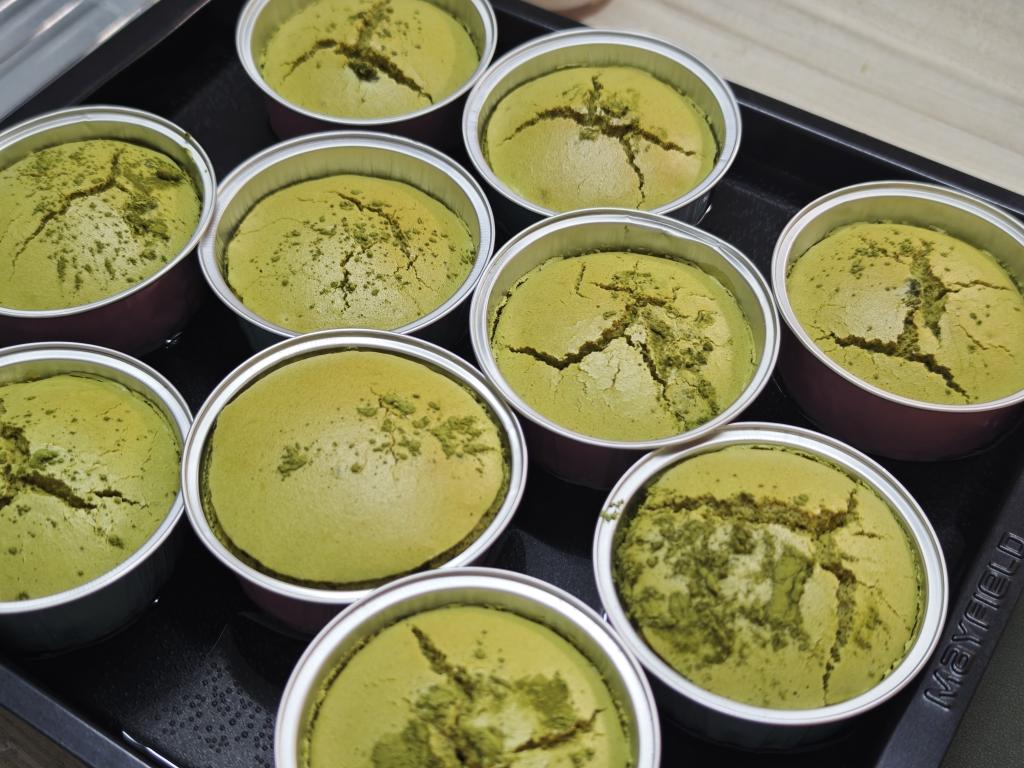
Prepare 10 foil cups.
Fill with batter to 80% capacity. (Note: the matcha batter portion is relatively smaller.)
To enhance the tea aroma and appearance after baking, sprinkle some matcha powder on the surface. (A dedicated powder shaker bottle is recommended.)
Add clean water to the baking tray to a height of 1.5 cm.
Place in the oven and bake at 150°C–155°C for 35–40 minutes.
Avoid high temperatures, as they cause the aroma of matcha to dissipate.
At the 20-minute mark of baking, cover the surface with silicone-coated parchment paper to prevent the top from drying out, losing moisture, and cracking. Appearance after 20 minutes of baking. Because the batter was too thick, the tension during baking was excessive, resulting in severe cracking. Next time, adjust the batter until it is smooth and flows slowly, which will make cracking less likely. Appearance after 30 minutes of baking. Depending on the temperament of each oven, it is best to insert a clean toothpick into the center of the cake to test doneness. If the toothpick comes out clean without any batter clinging to it, the cake is fully baked. If wet batter remains on the toothpick, continue baking. Invert the cake to cool, which preserves a moist texture to the greatest extent. The cake surface was very dry and cracked, raising some concern that the interior might become too dry. After cooling, tasting revealed that it was exceptionally moist and not dry or hard at all. It qualifies as an excellent traditional-style castella cake and is well suited for refrigeration; it can be stored in an airtight container for 3 to 4 days. This time, a 6-inch cake pan was used to replicate the recipe. The cake cracked and was relatively firm. The temperature and time used were 150°C for 65 minutes. Next time, adjustments will be made by baking at 145°C and covering the surface with silicone-coated parchment paper.