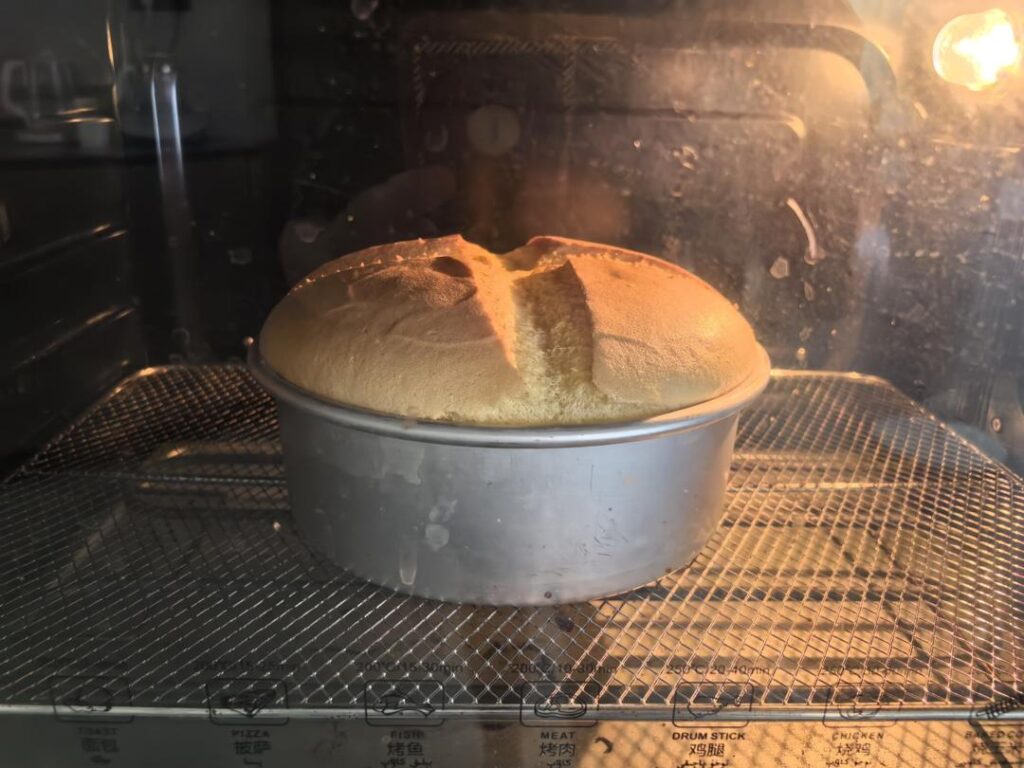
Every time I bake a chiffon cake, I cannot control the random cracks. Since I discovered this scoring method, I have decided: if it is going to crack, let it crack in a regular pattern.
Ingredients:
Lemon juice: 3 to 4 drops
Salt: a pinch 🤏 Place 60 g corn oil in a bowl, add 60 g water or milk, and mix until evenly combined. Add 80 g cake flour and mix until evenly combined. Separate the egg yolks from the egg whites. Place the egg yolks into the batter and the egg whites into an oil-free, water-free bowl. Stir the egg yolks and batter until evenly combined (photo not taken). Add a few drops of lemon juice to the egg whites to remove any unpleasant odor. Add a pinch of salt to enhance sweetness. Add a small pinch 🤏 of salt. Add 60 g granulated sugar.Preheat the oven to 150°C with both top and bottom heat before starting to whip the egg whites.
Begin whipping the egg whites at the highest speed setting.
Once the egg whites begin to foam, switch to the medium speed setting.
Whip in circular motions, moving back and forth and side to side, and continue whipping continuously.
When resistance is felt from the mixer, turn off the hand mixer and gently lift it to check whether the egg whites form small soft peaks with a slight curl. If the peaks are still long and curved, whip at low speed for a few more turns and check again.
After whipping the egg whites, invert the bowl and tap it lightly to confirm that the egg whites no longer flow.
Fold two spoonfuls of the whipped egg whites into the egg yolk batter using a stir-fry folding motion.
Add another two spoonfuls of whipped egg whites to the egg yolk bowl and continue folding with the same stir-fry motion.
Finally, pour all of the egg yolk batter back into the bowl with the remaining whipped egg whites and fold again using the stir-fry motion.
After combining the egg yolk batter with the meringue, pour the mixture from a height into an aluminum chiffon cake pan. Smooth the surface, then lift the pan and gently tap it against the counter a few times to release large air bubbles. This prevents large holes from forming inside the baked cake. (I forgot to take photos.)
Once the batter is in the oven, set both the top and bottom heat to 100°C. Do not use high heat at the beginning, as the surface will dry out too quickly and the cake will be more prone to cracking.
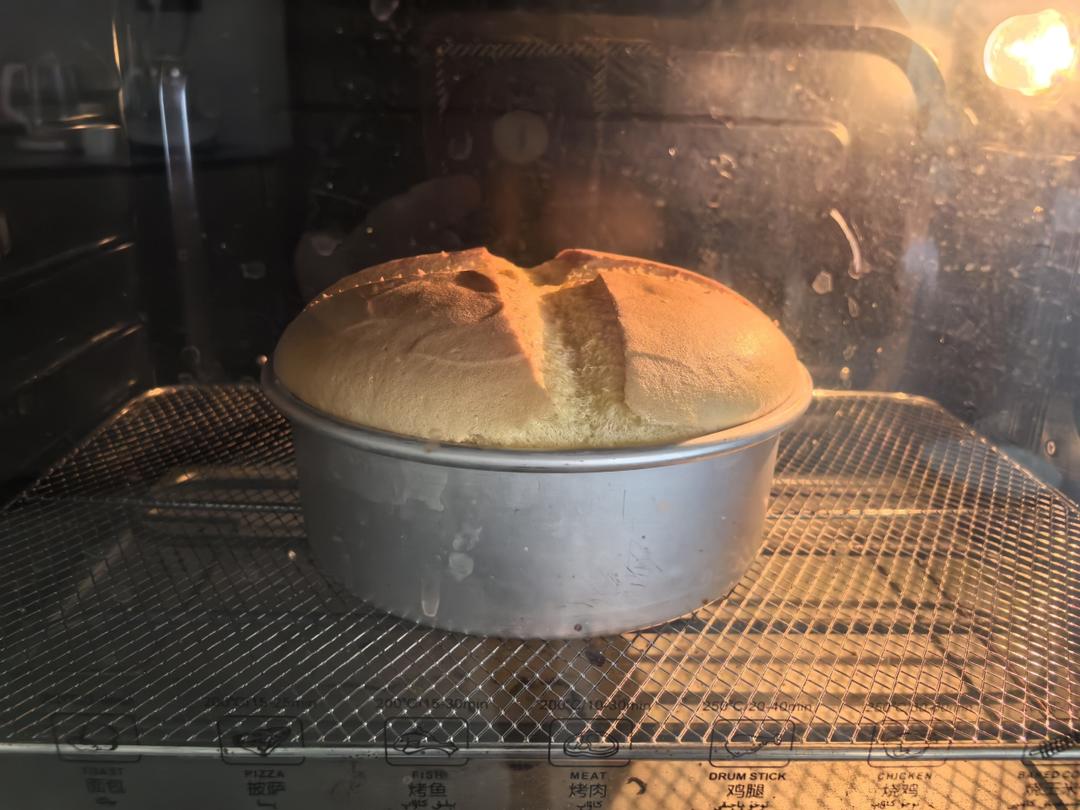
After baking at 100°C for 25 minutes, put on heat-resistant gloves, pull out the wire rack slightly, and use a small knife to gently score two intersecting lines on the surface of the cake. You may also create your own patterns. After scoring, return the cake to the oven and increase the temperature to 130°C.
Continue baking for 25 minutes. After 20 minutes, if the surface has not browned sufficiently, increase both the top and bottom heat to 150°C.
After a total baking time of 50 minutes, when the surface is browned to your satisfaction, turn off the oven, put on gloves, remove the cake pan, and quickly tap it twice against the counter to release the hot air inside. Immediately invert the pan and let the cake cool.
Once the cake has cooled, unmold it.
Cut into 8 equal portions and place in boxes.